Ultrasonic Skin Scrubber (Spatula) vs Ultrasound Facial Device: What’s the Difference?
Both are called “ultrasonic,” both have a flat metal head, and both claim to help your skincare absorb. But a skin spatula such as the $109 DERMAPORE+ and a $399–$1,100 ultrasound device work at very different frequencies and do different jobs.

The short answer: an ultrasonic skin scrubber (or “skin spatula”) is a cleansing and exfoliating tool: a metal blade vibrating at kilohertz frequencies on wet skin to loosen oil, debris and dead skin. An ultrasound facial device is a skincare treatment tool that runs at megahertz frequencies through a gel layer and is sold for absorption, firmness and glow. If you want clearer-feeling pores, buy a scrubber. If you want a daily anti-aging ritual built around your serums, look at ultrasound devices. Many people use both.
Ultrasonic skin scrubber vs ultrasound facial device, side by side
| Ultrasonic skin scrubber | Ultrasound facial device | |
|---|---|---|
| Frequency | Kilohertz range: typically 20–30 kHz (Vogue); DERMAPORE+ says 35 kHz | Megahertz range: e.g. Titan 1, 3, 10, 19 MHz; THOME 3 + 10 MHz |
| What vibrates | A flat metal blade (the “spatula”) | A transducer behind a flat metal head |
| Skin prep | Skin kept wet (water, mist or cleanser) | A layer of water-based gel or serum |
| Main job | Surface cleansing and gentle exfoliation; loosening oil and debris in pores | Marketed for skincare absorption, firmness and glow |
| Product “infuse” mode | Often (e.g. DERMAPORE+ Infuse mode) | Core use: applied over gel or serum |
| How often | Dermatologists in Byrdie suggest 2–3 times a week | Brand-dependent; often daily or several times a week |
| Typical price | e.g. $109 (DERMAPORE+) | e.g. THOME $399 list; MiniTitan $399 regular†; Titan $1,100† |
Prices checked October 8, 2026 on brand sites. † GlowLab Reviews and Quadthera US have common ownership. We may benefit financially from purchases of Quadthera products.
What an ultrasonic skin scrubber does
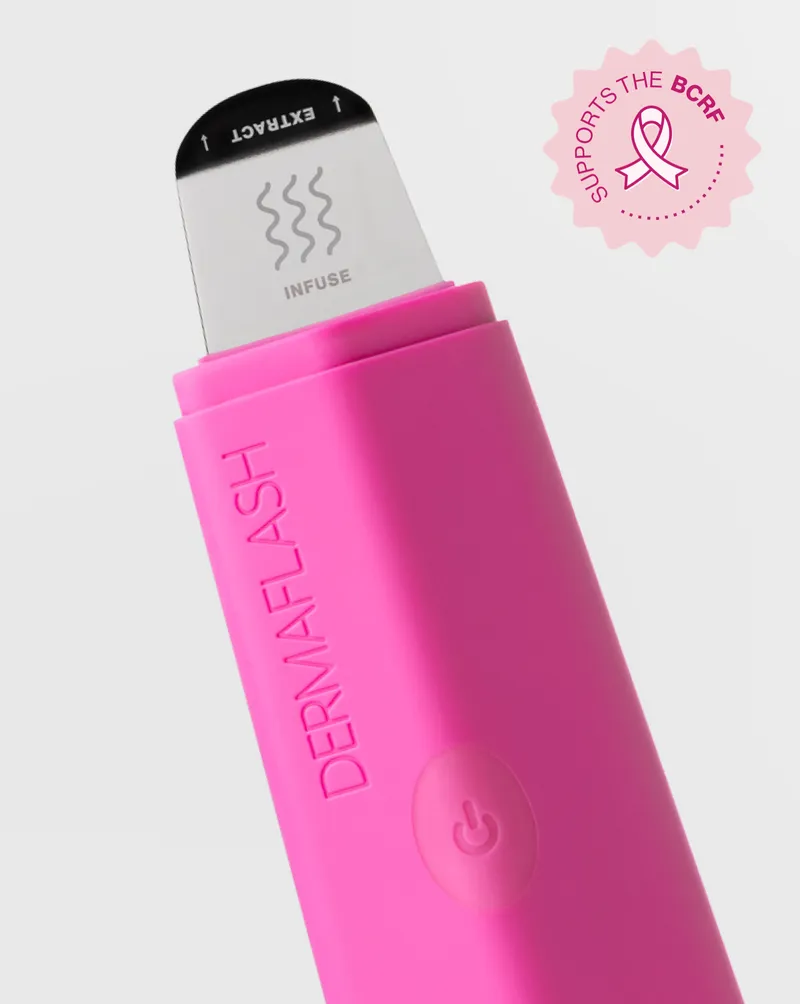
A skin scrubber vibrates a thin metal blade very fast. On wet skin, the vibration and water loosen surface oil, debris and dead cells, which you see collect on the blade. Dermatologist Michele Green told Vogue these devices typically run at 20,000–30,000 Hz and help decongest pores “without the harshness or trauma associated with physical scrubs or manual extractions” (Vogue). Dermatologist Scott Paviol told Byrdie they suit people who don’t tolerate scrubs, brushes or peels, including sensitive, rosacea-prone and acne-prone skin types (Byrdie).
A typical example is the dermaflash DERMAPORE+ ($109). dermaflash says it runs at 35 kHz, adds an “ionic” charge to the blade, and has two modes: Extract (blade tip angled on wet skin) and Infuse (flat side over your serum). It comes with a 0.5 fl oz Prep Mist. Its “97% had a significant reduction in pore size” figure comes from brand testing measured immediately after one use, so read it as a short-term effect (dermaflash).
What an ultrasound facial device does
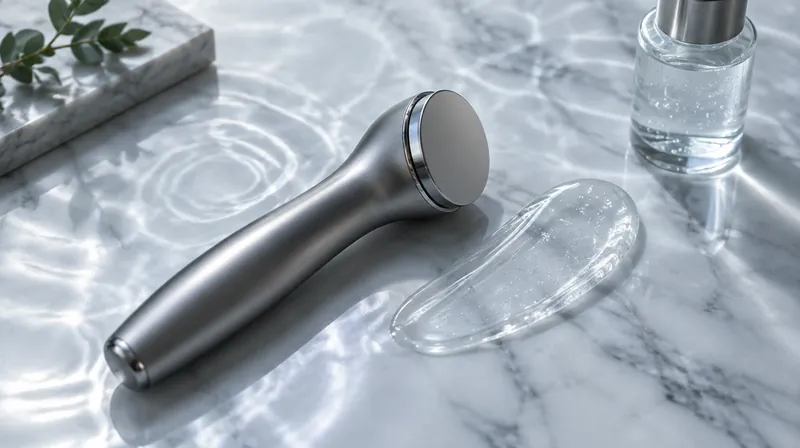
An ultrasound facial device uses a transducer to send megahertz-range ultrasound into the skin through a layer of gel or serum, which is needed because ultrasound doesn’t travel well through air. You glide it slowly over the face for several minutes. Brands sell them for skincare absorption, firmness and glow; the evidence for those claims is mostly small, brand-run studies, which we cover in what at-home ultrasound skincare is (and isn’t). They are not HIFU: home devices use low-intensity, non-focused ultrasound, not the focused energy of clinic treatments such as Ultherapy (see HIFU vs Ultherapy).
Examples range from THOME The Glow (3 and 10 MHz, $399 list; our review) to the Quadthera Titan† (1, 3, 10 and 19 MHz, $1,100; our review). Compare them all in the best at-home ultrasonic facial devices.
Why kHz vs MHz matters
Ultrasound means sound above about 20 kHz, so both tools qualify. The difference is scale: 1 MHz is 1,000 kHz, so even the Titan’s lowest setting is about 29 times the 35 kHz frequency of DERMAPORE+. Two practical consequences:
- Different targets. A scrubber’s blade works mechanically at the surface with water. Megahertz devices are designed to deliver energy into the skin through gel, and in general higher frequencies act more superficially and lower ones reach deeper, which is why multi-frequency devices offer several settings.
- The “absorption” science points both ways. The strongest skin-permeability effects in drug-delivery research come from low-frequency ultrasound below 100 kHz (Mitragotri & Kost, 2004). That research used lab equipment and set-ups unlike either consumer tool, so it doesn’t prove that a $40 spatula or a $1,100 device boosts your serum by a meaningful amount.
Which should you buy?
- Buy a skin scrubber if your main goals are congested pores, blackheads on the nose and chin, and a gentle alternative to scrubs and peels, on a budget.
- Buy an ultrasound facial device if you want a gentle, barely felt anti-aging routine to use most days with your serums, and you’re comfortable paying more for gradual, modest changes.
- Neither, if your priority is wrinkles with the strongest evidence: look at FDA-cleared LED masks.
How to use an ultrasonic skin scrubber safely
- Cleanse, then keep your skin wet the whole time (water, a facial mist or cleanser). Using it on dry skin increases friction and irritation, Dr. Green told Vogue.
- Hold the blade at the angle your manual specifies (dermaflash says about 45°, tip pointing down, for Extract mode) and glide it lightly; don’t press.
- Wipe the blade as debris collects.
- Follow with serum, using the infuse mode if your scrubber has one, then moisturizer.
- Limit it to two to three times a week (Byrdie’s dermatologists). Skip active or inflamed acne, wounds, sunburn and healing skin (Vogue; dermaflash).
Frequently asked questions
Is an ultrasonic skin scrubber the same as an ultrasound facial?
Do ultrasonic skin scrubbers work?
Is an ultrasonic skin spatula good for blackheads?
How often should you use an ultrasonic skin scrubber?
Can you use a skin scrubber and an ultrasound device together?
Which is better for anti-aging?
Sources
- dermaflash DERMAPORE+ product page
- Byrdie: How to Use an Ultrasonic Skin Scrubber Safely and Effectively
- Vogue: The Ultrasonic Skin Scrubbers I Reach For When My Skin Feels Congested
- Mitragotri S, Kost J. Low-frequency sonophoresis: a review. Adv Drug Deliv Rev. 2004
- Quadthera Titan product page†
- Quadthera MiniTitan product page†
† GlowLab Reviews and Quadthera US have common ownership. We may benefit financially from purchases of Quadthera products.